Total Productive Maintenance: The 8 Pillars, KPIs, and Implementation Plan
Total productive maintenance (TPM) is a company-wide operating system that engages production, maintenance, quality, engineering, safety, and support teams in preventing equipment losses.
What is total productive maintenance?
Total productive maintenance (TPM) is a management system for improving production-system effectiveness by preventing equipment-related loss across the asset life cycle. The Japan Institute of Plant Maintenance introduced TPM in 1971 and describes it as participation across functions and levels, not a maintenance-department project. The practical aim is to make abnormalities visible, restore basic equipment conditions, remove recurring losses, improve skills, and design future equipment and processes for reliable operation.
The eight pillars of TPM
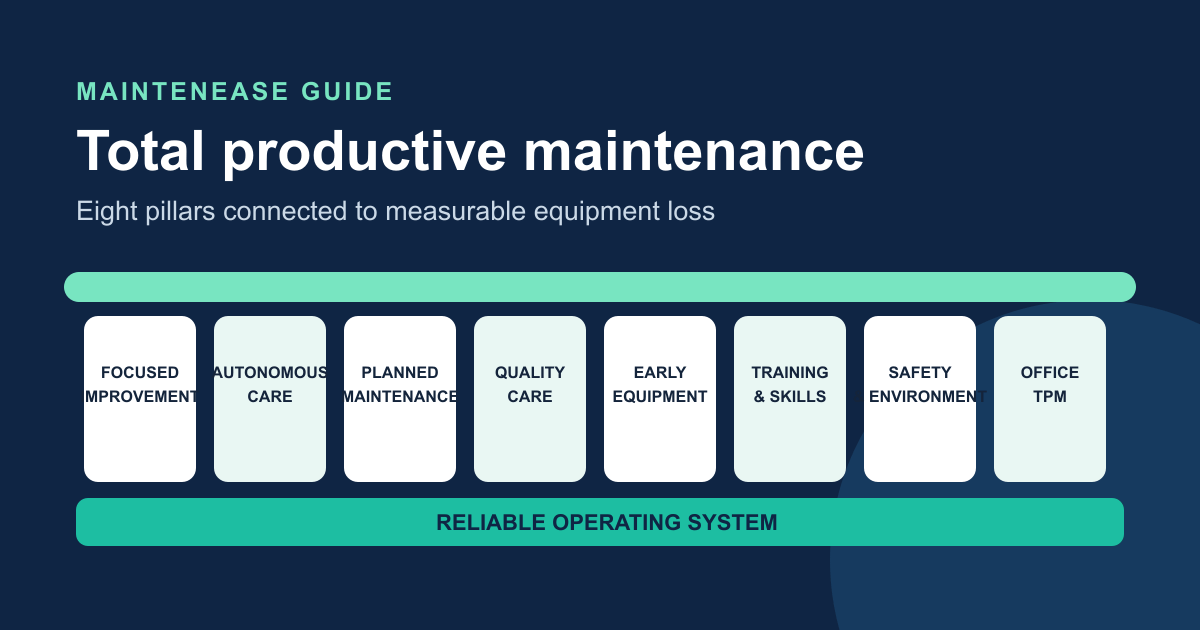
The pillars work as one system. Autonomous maintenance gives operators clear daily ownership without turning them into maintenance technicians. Planned maintenance controls technical work. Focused improvement removes chronic losses, while quality, early equipment management, training, safety, and administrative TPM prevent the same losses from being designed or managed back into the operation.
A phased 30/60/90-day TPM implementation plan
A 90-day plan should prove the operating model on one pilot area, not claim company-wide TPM maturity. Choose a constrained line or asset family with visible loss, stable leadership support, and enough data to establish a baseline. Expand only after roles, standards, escalation, and review routines work in practice.
TPM KPIs and calculations
Use a small, balanced scorecard. OEE summarizes productive use of planned production time, but it can hide the source of loss, so retain the availability, performance, and quality components. Maintenance metrics explain whether equipment reliability and restoration are changing. Review hours and event counts behind the percentages so a small denominator does not create a misleading trend.
TPM audit worksheet
Score each statement from 0 to 3: 0 means not defined, 1 means documented but inconsistent, 2 means routinely followed, and 3 means verified and improving. Require evidence for every score. A high self-rating without current records is a discussion prompt, not an audit result.
How work orders and asset history support TPM
TPM depends on evidence moving across teams. Operator findings should create traceable work rather than disappear on a board. Work orders preserve the symptom, loss category, asset, priority, labor, parts, cause, repair, downtime, and verification. Asset history then shows recurring failures, interval performance, restoration time, and the effect of countermeasures. A CMMS does not create participation, but it gives the pilot one shared operational record and prevents each pillar from maintaining a separate spreadsheet.
TPM vs preventive, RCM, and lean maintenance
These approaches overlap but answer different questions. TPM is the broad participation and loss-elimination system. Preventive maintenance is a work strategy inside it. Reliability-centered maintenance selects appropriate policies by functions, failures, consequences, and technically effective tasks. Lean maintenance applies lean thinking to maintenance flow and waste. A plant can use RCM to redesign the maintenance program, execute selected PM and condition tasks through a CMMS, and sustain the routines through TPM.
Common TPM implementation failures
TPM stalls when it becomes a cleaning campaign, a maintenance-only project, or an OEE reporting exercise. Other warning signs include unsafe transfer of technical tasks to operators, too many pilot assets, scores without evidence, unresolved red tags, PMs copied from manuals without failure-mode logic, and improvement events whose gains never become standard work. Leadership must protect time for the routines and remove cross-functional barriers that the maintenance team cannot solve alone.
What does TPM stand for?
TPM stands for total productive maintenance. It is a cross-functional management system for preventing equipment and production losses across the asset life cycle.
What are the eight pillars of total productive maintenance?
Focused improvement, autonomous maintenance, planned maintenance, quality maintenance, early equipment management, education and training, safety-health-environment, and office TPM are the classic eight pillars.
Is autonomous maintenance the same as operators repairing machines?
No. Autonomous maintenance gives trained operators defined, safe tasks such as cleaning, inspection, lubrication, basic adjustment, and abnormality tagging. Technical repairs and safety-critical work remain with qualified personnel.
How is OEE calculated?
OEE equals availability multiplied by performance multiplied by quality. Use decimals or percentages consistently, and review the three components separately to locate the loss.
Can a company implement TPM in 90 days?
A company can establish and evaluate one TPM pilot in 90 days. Company-wide behavior, standards, and improvement routines take longer and should expand only after the pilot is stable.
Does TPM require CMMS software?
No, but a CMMS helps preserve work orders, asset history, operator findings, PM schedules, failure codes, labor, parts, and KPI inputs in one shared record.